
The AEO Workshop: A 90-Minute Internal Training Outline
A run-of-show for a 90-minute internal AEO training that gets a marketing team from zero knowledge to a working brand audit and action backlog in a single session.
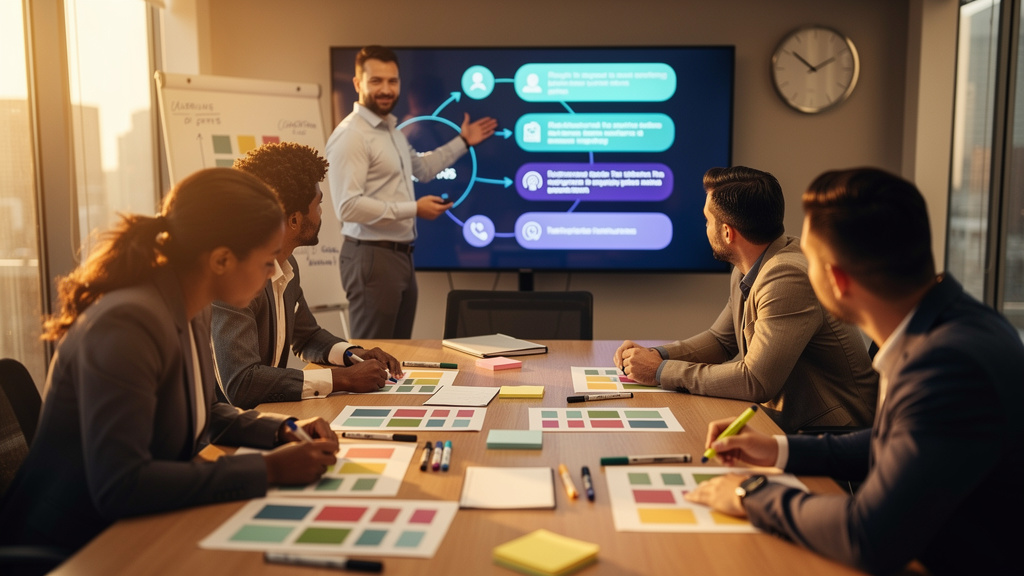
Key Highlights
- Most enterprise marketing teams need an internal training before they can support an AEO program well, and most existing AEO trainings are too long, too theoretical, or too vendor-pitch-shaped to actually shift behavior.
- A 90-minute workshop, run well, can take a marketing team from zero knowledge to a working understanding of AEO, a live audit of their own brand, and a five-item action backlog by the end of the session.
- The agenda has six segments: framing (10 min), AEO vs SEO mental model (15 min), live citation walkthrough (20 min), brand audit exercise (20 min), action backlog (15 min), Q&A (10 min).
- The single most important design choice is making at least 40 minutes of the workshop participatory, not lecture, because AEO concepts stick when the team sees their own brand inside an AI response, not when they hear about citations in abstract.
Why most internal AEO trainings fail
Enterprise marketing leaders ask the question often. "How do I get my team up to speed on AEO without losing a week to training." The honest answer is that most AEO training fails for one of three reasons, and avoiding all three is the design constraint for a workshop that actually works.
The first reason is length. A two-day AEO bootcamp loses people by hour three. The team is busy, the concepts feel abstract, and the attention drops off long before the practical material lands. A 90-minute session forces ruthless prioritization, which is exactly what an enterprise team needs.
The second reason is theory before practice. Most AEO trainings spend the first 60 minutes explaining how large language models work, what training data is, and how RAG pipelines differ from base model inference. None of this changes what the team does on Monday. The team needs to see citations, see their brand inside or absent from an AI response, and feel the gap.
The third reason is the vendor pitch shape. Many AEO trainings are thinly disguised sales presentations from a vendor trying to win the agency contract. The team can smell it within ten minutes, and the credibility of every later point drops. A useful internal workshop is run by someone who is not selling, even if it is an external partner.
The 90-minute workshop below is designed against all three failures.
The full 90-minute agenda
The agenda is shaped to move from concept, to evidence, to participation, to commitment. Each segment has a defined output. By the end, the team should be able to articulate why AEO matters, identify three citation gaps in their own brand, and own at least one action.
| Segment | Time | Output |
|---|---|---|
| Opening framing | 10 min | Shared understanding of what the workshop will and will not cover |
| AEO vs SEO mental model | 15 min | One-page diagram showing how the two disciplines differ and overlap |
| Live citation walkthrough | 20 min | Live demo of brand citation patterns across four AI models |
| Audit your own brand exercise | 20 min | Each participant has run three queries about their own brand |
| Action backlog | 15 min | Five-item action list with named owners and timeframes |
| Q&A | 10 min | Open answers, plus one written question per participant captured for follow-up |
The total adds up to 90 minutes with no buffer. In practice, allow 100 minutes on the calendar to absorb late arrivals and a five-minute mid-point break.
Segment one: opening framing (10 minutes)
The opening is short and definite. Three slides. First slide: what AEO is and why we are running this workshop. Second slide: what the workshop will cover and what it deliberately will not (no model architecture, no token theory, no vendor pitch). Third slide: what each participant should walk out with (a clearer mental model, an audit of their own brand, and one action they own).
The framing should also set expectations on participation. State explicitly that 40 of the 90 minutes will require active work, not just listening. People behave differently when they know participation is coming.
The facilitator should be the person on the team or partner team with the most operational AEO knowledge. Not the most senior person. The most operational. Seniority comes in during the action backlog segment.
Segment two: AEO vs SEO mental model (15 minutes)
This segment exists because every marketing team has a strong SEO mental model and tries to apply it to AEO. The result is misaligned expectations and wasted budget. The 15 minutes here saves months of confusion later.
The core teaching is a single comparison diagram, drawn live on a whiteboard or shown as one slide.
| Dimension | SEO | AEO |
|---|---|---|
| Primary goal | Rank in search results | Be cited in AI responses |
| Primary signal | Backlinks, on-page, intent | Authority, structure, entity, mention frequency |
| Measurement | Rankings, organic traffic | Citation share, mention frequency, AI-attributed pipeline |
| Time horizon | 3 to 9 months | 6 to 18 months |
| Content shape | Long-form, keyword-targeted | Answer-shaped, semantically complete |
| Distribution | Crawler-discoverable | Crawler plus cited reference sources |
After the table, draw the overlap. About 40 percent of AEO work is built on SEO foundations (technical health, crawlability, structured data). About 60 percent is genuinely different and requires new skills (citation tracking, entity work, in-language placements, answer-shaped content). This proportion is the most important thing the team will take away from this segment.
Segment three: live citation walkthrough (20 minutes)
This is the segment that changes the room. The facilitator runs a live query in ChatGPT, Claude, Gemini, and Perplexity, projected on the screen, asking a real category question the brand would want to be cited for.
Choose a query that is meaningful for the team. For a B2B SaaS company, something like "what is the best [category] tool for a 200-person company" works. For a consumer brand, something more specific to the category. The facilitator runs the same query in all four models and reads the responses aloud.
The team watches whether the brand is named, which competitors are named, what sources are cited as the basis for the response, and how the answers differ across models. In most cases, the brand is either absent or cited differently across models. This is the visceral moment that makes AEO real for people who have only heard about it.
After the four queries, spend five minutes on a structured debrief. What patterns did you notice across models. Which competitors showed up consistently. What sources were cited (and were any of them ours). This conversation is more valuable than any slide.
Segment four: audit your own brand exercise (20 minutes)
The exercise is simple. Each participant takes 15 minutes to run three queries about the brand in any of the four AI models they have access to. They write down, in plain language, what they observed.
Provide a structured worksheet with three boxes per query. Box one: what was the response. Box two: was the brand cited, and if so, how (mention, link, full quote). Box three: who else was cited, and what source provided the response.
After 15 minutes, run a five-minute share-out. Each participant names one observation. The patterns emerge fast: citations cluster around a small number of sources, the brand appears more in some query types than others, and competitor citations are concentrated on a few comparison sites.
The output of this segment is a shared list, written on the whiteboard, of three to five citation gaps the team has observed firsthand. This list seeds the action backlog.
Segment five: action backlog (15 minutes)
The action backlog segment converts insight into commitment. The facilitator opens this segment by saying that the next 15 minutes will produce five actions, each with a named owner and a timeframe of "this week," "this month," or "this quarter."
The actions should come from the gaps identified in segment four. For each gap, the team agrees on the single most leveraged action to close it. Examples that come up often: rewrite the FAQ on the product page to match the actual queries seen during the audit, commission a competitive citation benchmark across the top five competitors, schedule a structured data implementation review with the engineering team, draft three pillar pages targeting the category queries the brand was absent from, and identify two industry publications worth pitching for placement coverage.
The senior person in the room confirms each action verbally. This is the moment to use seniority, because verbal sign-off in a room is much harder to walk back than a slide deck commitment.
Segment six: Q&A and capture (10 minutes)
The final segment is open Q&A, but with a written component to make sure quiet participants are heard. The facilitator asks every participant to write one question on a sticky note before the open conversation begins. The sticky notes are collected and read out, even if some get answered during the live discussion. Anything not answered in the room becomes a follow-up.
End the workshop with a clear restatement of the five actions, the named owners, and the timeframe for the first check-in. A two-week check-in is the right cadence after a workshop like this. Anything longer and the energy dissipates. Anything shorter and there is not enough work to review.
Facilitator vs participant activities
The split of work between facilitator and participants is the design choice that determines whether the workshop produces real outcomes or polite nods.
| Activity | Facilitator role | Participant role |
|---|---|---|
| Opening framing | Present three slides, set expectations | Listen, ask clarifying questions |
| AEO vs SEO model | Draw comparison, explain overlap | Take notes, ask one comparison question each |
| Live citation walkthrough | Run queries, narrate observations | Watch, note patterns, contribute to debrief |
| Brand audit exercise | Provide worksheet, time the segment | Run three queries, complete worksheet |
| Action backlog | Facilitate, capture commitments | Propose actions, accept ownership |
| Q&A | Answer, capture unanswered for follow-up | Write one question, ask in open round |
Roughly 50 minutes of facilitator-led time, 40 minutes of participant-led time. Workshops that drift to 70/20 lose the room and produce no actions. Workshops that drift to 30/60 feel chaotic and produce confused actions. The 50/40 split is the version that works.
When to bring in an external facilitator
Most enterprise teams can run this workshop internally if they have one strong AEO operator on the team. The facilitator does not need to be a deep expert. They need to be willing to run live queries in front of the team, narrate the patterns, and lead the audit exercise without defaulting to lecture.
If no one on the team has run a structured AEO program before, an external facilitator is usually worth the investment, because the live citation walkthrough is the segment that requires real-time judgement. Misreading what a citation pattern means in front of the team can do more damage than a missed segment.
OnlyAEO has facilitated this workshop format for enterprise marketing teams across SaaS, financial services, and consumer brands. The 90-minute structure holds up consistently. The teams that get the most out of it are the ones that schedule the two-week check-in before the workshop ends, and that treat the five-action backlog as a real commitment rather than an artifact of the session.
A 90-minute workshop will not turn a marketing team into AEO experts. It will get them aligned, oriented, and committed to the first round of real work. For most enterprise organizations, that is the bottleneck holding back the broader program, and it is the bottleneck the workshop is designed to remove.
Get your free AI visibility audit
OnlyAEO will facilitate a tailored 90-minute internal AEO workshop for your marketing team, including the live brand audit and a documented action backlog you own afterward.
Get Your Free AuditFrequently Asked Questions
How many people should attend the 90-minute AEO workshop?+
Can the workshop be run remotely or does it need to be in person?+
What should we do between the workshop and the first check-in?+
Is 90 minutes really enough to make a difference?+

OnlyAEO
Expert insights on Answer Engine Optimization and AI visibility strategy.
Related Articles

AEO RFP Template: 28 Questions to Evaluate an Agency Honestly
A 28 question AEO RFP template organized into seven evaluation buckets, with scoring guidance and the answer patterns that distinguish strong agencies.
Read article
The AEO Vendor Shortlist Memo: A One-Page Template for Procurement
A one-page AEO vendor shortlist memo template for enterprise procurement teams. Compare answer engine optimization vendors on the dimensions that actually matter.
Read article
AEO RFP: Questions to Ask Before Signing an Agency
A defensible AEO RFP covers seven categories: methodology, measurement, deliverables, team, references, pricing transparency, and exit terms. This is the list OnlyAEO recommends.
Read article